EPOXY FLOOR PAINT
keywords=best epoxy floor paint
DIY: Epoxy Floor Paint --- Self Test
10 questions you need to know/ask regarding epoxy floor paint coatings
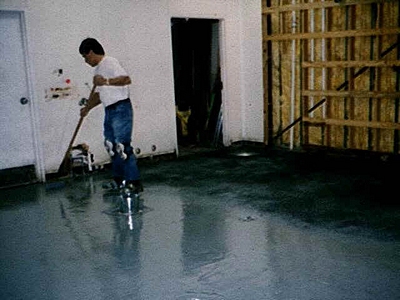
Too many Internet sellers of epoxy resin floor paint products for garage, basement, or walkway
surfaces keep their potential customers in the dark about alternative options, different kinds of epoxies, and
possible problems. Two part epoxy paint products are NOT like enamel floor paint you can buy at the local hardware
store. Educate yourself before you spend your money.
#1) There are water based floor epoxies, solvent based systems, and solvent free epoxy floor coatings. There are
good and bad things about each. Do you know which is best for you?
#2) Do you know that epoxies are not color stable and will yellow over time and especially in direct sunlight?
If color stability is important to you, you will probably need to use both epoxy and some other type of paint/coating.
Do you know what your non epoxy topcoat options are?
#3) Some epoxy products require you to mix the two part epoxy and then let it sit in the container for a certain
amount of time. Is this a good thing or a red flag?
#4) Many people like the "paint chip" look often seen in garage floor epoxy paint systems. Are you aware
that there are several methods and several different epoxy/non epoxy combination of products to achieving this
look? Just sprinkling the chips upon the surface of the wet pigmented floor epoxy is the least professional, least
commercial way to achieve that look.
#5) With products like epoxy resins and seamless floor products there are product data sheets and legally required
Material Data Safety Sheets associated with them. These documents contain real information and get you past the
marketing hype found in the bulk of the vendor's site. After viewing an epoxy vendor's site, you should be easily
able to access the data and msds information. Companies that don't make these available to you may be hiding something
or else don't want you to have enough real information to compare their product to their competitor's products.
#6) We recommend you call or email the company you are planning to purchase from. It can be a simple question like,
"When will the order ship?" or "Why did the chicken cross the road?" If the don't reply back
in a timely fashion before they have your money, the certainly will not reply to you after the sale! Buying online
from out of state companies has more risk than buying at your local hardware store - you do have legal options
but they don't come cheap!
#7) If you have experienced "hot tire pickup' - places where the epoxy lifts off under where your tires sit,
or just peels off in sheets. Is this 'bad epoxy paint" and should you demand a refund? (few American made
products are defective - the problem here is surface preparation which is your responsibility, or issues with the
concrete - which is outside of your control and the control of the epoxy manufacturer. Each case in unique, and
you don't know if you did enough - or had a suitable surface - until after the fact. So, given these potential
issues, MAYBE you don't want to risk putting down an epoxy floor - it could fail with no one at fault).
#8) Concrete contains a lot of air spaces. Most concrete garage floor surfaces are 'vibrated' smooth to drive out
much of the trapped air. This is rarely done in sheds, barns, work shops, etc. So, when you apply a thick epoxy
to such surfaces air can come out of the concrete and form bubbles throughout the setting epoxy surface. Are you
aware if this, and do you have a plan to deal with it?
#9) If you are considering an epoxy floor because of water or dampness on the concrete, do you know that the moisture
might be coming from either condensation out of the air, or from water moving up through the garage floor? An epoxy
coating might help in the second case, if you can get it to bond to the damp floor. It probably will not help if
the wetness comes from out of the air.
#10) Do you know that epoxy floor paint surfaces can produce a finish that is slippery when wet, like glazed tile
or a marble floor? There are many different anti slip non slip grit type products you can use. Do you know there
are several different methods for applying the grit to the coating? Do you know which type or size grit to use
if you are applying and epoxy floor to a fire station vs. inside a shower stall? Fine textured grits get lost in
thick epoxies, have you matched the grit size to the epoxy thickness (as well as to the floor application)?
For articles that address and answer these epoxy questions and teach you the basics of epoxy paint systems--- CLICK HERE..
Click here for
massive web link site covering everything related to floor epoxy prep, issues,
products
PAGE SPONSORS:
.Ask Professor E.Poxy...
|
ONLINE PRODUCT
CATALOGS
PROGRESSIVE EPOXY
POLYMERS, Inc
|
A COMMERCIAL - INDUSTRIAL -
PROFESSIONAL PRODUCT |
|
You won't find these products, or products like it, in
a general purpose, mass market, consumer, DIY, box store or flashy
marketing company website.
|
|
|
|
ONLINE STORE
Purchase Here ------ or CALL 603 435 7199 ------
HOME
PAGE |
|
|
Marine Catalog |
|
* home
page of marine catalog section (blue background)
* table
of contents page for marine catalog section
|
|
Section One MARINE - CLEAR EPOXIES
Section Two FILLERS THICKENERS ADDITIVES
Section Three THICKENED EPOXIES - EPOXY PUTTIES, ETC.
Section Four EPOXY PAINTS (barrier coats)
Section Five URETHANES AND NON-EPOXY COATINGS
Section Six NON-SKID DECK COATINGS
Section Seven MARINE REPAIR PRODUCTS
Section Eight MISC. MARINE PRODUCTS |
|
|
MASSIVE BOAT HOW TO
- ISSUES -
HELP WEB LINK SITE |
|
| |
|
|
Residential /
Commercial / DIY Catalog |
|
* home
page of residential/commercial catalog section (brown background)
* table
of contents page for residential/commercial catalog section
|
|
Section A EPOXY PAINTS
Section B FLOOR EPOXIES (regular and non-skid products), SEALERS, ACCESSORIES
Section C THICKENED EPOXIES - EPOXY PUTTIES, ETC.
Section D CLEAR EPOXIES
Section E NON-EPOXY PAINTS COATINGS SEALERS
Section F MIX-IN ADDITIVES
Section G OTHER PRODUCTS
Section H SURFACE PREPARATION PRODUCTS
Section I MISC. ACCESSORIES |
|
|
WEB
EPOXY
FLOOR ISSUES LINKS SITE --- WEB
EPOXY
REPAIR LINKS SITE |
|
|
PRODUCT
DATA SHEETS -------
BY SUBJECT
INDEX HELP SITE |
|
|
top selling favorite
products for your every need
Buy
Talk Chat Support
EMAIL
or
603 435 7199
|
Let's stay connected.
It's a win-win situation. Receive
our online NEWSLETTER by
emailing us your name and email
address. |
American manufactured, distributed, and sold epoxies and
coatings.
Your business helps small
American Family Businesses - Thank You! |
|
epoxy floor paint DIY SELF TEST
10 questions you need to know/ask regarding epoxy floor paint coatings.